Showing posts with label LifeInChina. Show all posts

Sunday, 12 January 2014

The Celestial Empire

Merry Christmas and Happy New Year. I know, for Christmas I'm a bit late, but my PC was to the doctor, and at least for the new year I still have time! After holidays spent in lunches and dinners with friends, it is time to get back in motion, but keep calm ... tai chi style. So before I will read a bit. For Christmas I got a book by Margherita Hack on the myths and legends with which humanity has tried to explain the universe in the past millennia. Needless to say, a nice chapter is also dedicated to the Celestial Empire, and I've seen some of that things in my travel to china ... and now I'll tell you!


The Chinese cosmology had a political role and was closely linked to the regent dynasty. "The sky was divided in 5 buildings. The central building was located in the area surrounding the North Pole, a symbol of the imperial court and therefore had the highest position in Chinese cosmology. The circumpolar area was therefore built in the image and likeness of the imperial palace. The other 4 buildings were placed around the four cardinal stars along the ecliptic and were called the Palace of the East, South, West and North. Each palace representing one of the 4 seasons and, depending on the season, a temporary residence of the court."
Each building also represented one of the five elements that make up nature in Chinese mythology and is protected by one of the five mythological beasts, said Si Ling.
Qing Long, the blue dragon guardian of the East. It is associated with the spring, the colors blue and green, and the element wood, supports and defends the country (controls rain, symbol of imperial power). It is often coupled with Zhuque, the red phoenix, because both represent both the conflict is the joy of marriage. In both China and Japan, the dragon is a symbol of the emperor as the phoenix is symbol of the empress.
Zhuque, the Vermilion Phoenix, Guardian of the South is associated with summer, the color red, the element of fire. It is a symbol of knowledge, and luxuriant nature, occurs only in times of prosperity.
Báihǔla, the white tiger (or " Jade " ) Guardian of the West. It is associated with autumn, the color white, and the metal element. When you put some metal over a tomb, is a ceremonial connection with the tiger of jade, according to the Chinese Annals of Wu and Yue , three days after the burial of the king, the essence of the element metal took the form of a tiger jade and crouched down on the grave , becoming the protector. The white jade was often used to worship the god of the West, and took the name ' Jade Tiger ', for the Chinese the tiger was the king of all animals and lady of the mountains, so the jade tiger was an ornament reserved for commanders of armies. In particular, the male tiger was the god of war, and protected the Emperor's armies into battle, as well as from the demons in his grave.
Xuánwǔ the black turtle Guardian of the North. It is associated with winter, the color black, and the element of water, it is also a symbol of piety. It is often represented as a turtle with a snake coiled on its back. The turtle is a symbol of long life and happiness, and when a thousand years old, is able to speak the language of humans. The turtle is one of the Celestial Emblems, the symbol of wisdom and longevity, it is said that its shell is a strongbox for the universe. In particular, turtle and snake together are a symbol of longevity, it is said that their union put in danger the universe itself. It is interesting to note that in the beginning of all things Greek mythology the serpent of time (Chrono , not to be confused with the Titan Kronos, father of Zeus) revolved around the cosmic egg and breaking its shell gave birth to the Universe.

Finally Huanglong, the yellow dragon (or "golden") Guardian of the Center, and then the Imperial Palace, is more like a snake than the blue dragon. It is associated with the change of seasons, the color yellow, and the earth element.
Finally, going back to the theme of similarity with the West, it is interesting to note how two cultures distant and not connected have developed the same concept of nature based on fundamentals elements. Furthermore, the final solutions were extremely similar on to another. Four Elements in Greek culture and five in the Chinese and, moreover, three of these are common to both cultures. Indeed, we have Air, Water, Earth and Fire identified by Hippocrates in Greek culture and Water, Earth, Fire, Wood and Metal in Chinese culture.
I would say that as a beginning of the year that's enough.
Talk soon and may the Force be with us.


Saturday, 11 January 2014

L'impero celeste


Buon Natale e Felice anno nuovo. Si lo so, per il Natale sono un po’ in ritardo, ma il mio PC era dal dottore e comunque almeno per l’anno nuovo ho ancora tempo! Dopo un po’ di feste passate a pranzi e cene con gli amici è ora di rimettersi in movimento, ma con calma... in stile tai chi. Quindi prima mi do alla lettura. Per Natale mi è stato regalato un libro di Margherita Hack sui miti e leggende con cui l’umanità ha cercato di spiegare l’universo nei millenni passati. Inutile dire che un bel capitolo è dedicato anche al celeste impero e che alcune cose le ho viste anche io nei miei viaggi per la cina... e ora ve le racconto!!
La cosmologia cinese aveva un ruolo molto politico e strettamente legato alla dinastia reggente. “Il cielo era suddiviso in 5 palazzi. Il palazzo centrale era situato nell’area che circonda il Polo Nord, simbolo della corte imperiale e che dunque possedeva la posizione più alta nella cosmologia cinese. L’area circumpolare era dunque costruita ad immagine e somiglianza del palazzo imperiale. Gli altri 4 palazzi erano posti intorno alle quattro stelle cardinali lungo l’eclittica ed erano denominati Palazzo dell’Est, del Sud, dell’Ovest e del Nord. Ognuno rappresentava una delle 4 stagioni e, a seconda della stagione, una residenza temporanea della corte.”
Ogni palazzo rappresentava anche uno dei cinque elementi che compongono la natura nella mitologia Cinese ed è protetto da una delle cinque bestie mitologiche, dette Si Ling.
Qīng Lóng, il drago azzurro guardiano dell’Est. È associato alla primavera, i colori blu e verde, e l'elemento legno; sostiene e difende il Paese (controlla la pioggia, simbolo del potere imperiale). Spesso è accoppiato a Zhūqùe, la fenice rossa, perché entrambi rappresentano sia il conflitto sia la gioia del matrimonio. Sia in Cina sia in Giappone, il drago è simbolo dell'imperatore e la fenice dell'imperatrice.
Zhūqùe la fenice vermiglia Guardiana del Sud. È associata all'estate, il colore rosso, l'elemento fuoco. È simbolo di conoscenza, e natura rigogliosa; si manifesta solo in tempo di prosperità.
Báihǔla tigre bianca (o "di giada") Guardiana dell'Ovest. È associata con l'autunno, il colore bianco, e l'elemento metallo. Quando in una tomba si pone del metallo, è una connessione cerimoniale con la tigre di giada; secondo gli Annali Cinesi di Wu e Yue, tre giorni dopo la sepoltura del re, l'essenza dell'elemento metallo prese le sembianze di una tigre di giada e si accucciò sulla tomba, divenendone la protettrice. La giada bianca era spesso usata per venerare il dio dell'Ovest, e prese il nome di 'giada della tigre'; per i cinesi la tigre era il re di tutti gli animali e signora delle montagne, così la giada della tigre era un ornamento riservato a comandanti di eserciti. In particolare la tigre maschio era dio della guerra, e proteggeva le armate dell'imperatore in battaglia, oltre che i demoni nella sua tomba.
Xuánwǔ  la tartaruga nera Guardiana del Nord. È associata all'inverno, il colore nero, e l'elemento acqua; è anche simbolo di religiosità. È spesso rappresentata come una tartaruga con un serpente avvolto in spire sulla sua schiena. La tartaruga è simbolo di lunga vita e felicità; quando ha mille anni, è capace di parlare il linguaggio degli esseri umani. La tartaruga è uno degli Emblemi Celesti, simbolo di longevità e saggezza; si dice che il suo guscio sia la cassaforte dell'universo. In particolare tartaruga e serpente insieme sono simbolo di longevità; si dice che la loro unione mise in pericolo l'universo stesso. È interessante notare come nella mitologia greca all’inizio di ogni cosa il serpente del tempo (Chrono, da non confondere col titano Krono, padre di Zeus) girava attorno all’uovo cosmico e rompendone in guscio da inizio al tutto.
Infine Huánglóng, il drago giallo (o "d'oro") Guardiano del Centro, e quindi del Palazzo Imperiale, è più simile a un serpente rispetto al drago azzurro. È associato al cambio delle stagioni, il colore giallo, e l'elemento terra.
Infine, tornando al tema delle similitudine con l’occidente, è interessante notare come due culture lontane e non comunicanti abbiano sviluppato il concetto di natura basata su elementi fondamentali. Inoltre le soluzioni finali sono state per altro estremamente simili. Quattro Elementi nella cultura greca e cinque in quella Cinese e per altro tre di questi sono comuni ad entrambe le culture. Infatti abbiamo Aria, Acqua, Terra e Fuoco identificati da Ippocrate nella cultura greca e Acqua, Terra, Fuoco, Legno e Metallo nella cultura Cinese.
Direi che come inizio anno basta cosi.
Alla prossima e che la Forza sia con noi. 


Friday, 19 July 2013

Power is nothing without control.

To prevent too much Force turning me into a superman, a gift of which I am not worthy, I took a nice dysentery followed by cold, resulting in one week of rest during which I trained only two or three hours a day. During this time I have spent a bit to talk with the Chinese and about the Chinese.

Let’s say that China is a big country, and as a result I've seen just a bit of it, the province of Hennan, but I found something significant. I'll try to describe it. I am sure you have in mind at least one story or movie where the main character from the past is thrown into the modern era ... Here is China. An entire country, as big as a continent, and with an incredible population, stolen to ‘700 and slammed in 2013!

In rural areas this clash is even more striking because, in contrast to our rural areas who are usually happy to be such, here is racing to be modern (modern = better), but then you find people who sows the wheat in the middle of the road or the basketball court. Small children running around with their pants cut in the middle of the legs ... So if nature calls it is a moment to do it in the middle of the street. Electric motors, adopted massively by the government to reduce pollution, are sided by the custom of peasants to burn the waste in the backyard ... Including plastic waste!

China is also a country that desperately tries to understand that foreign policy has changed from ‘700 ... Today, if you make war to a nation you find the whole world looking at you. And then how do you say to all those Chinese to which has been repeated for decades that the Japanese were the bad guys (having a common enemy is good for national unity!) that one cannot simply go to war, because it could not be a good move? How do you hold together a nation as large as a continent in a variety of different ethnic groups (who often hate each other) without having a common enemy that holds them all together (more or less)?

Tibet and Xinjiang (country of origin of the Turks) want to get away from China (and half the land is gone). China does not want it, but Chinese do not want to live there and they don t spend a penny to make the area more livable. As a result, ethnic minorities are living in half of the country, but in that area they are the majority and then they want indipendence. Hong Kong is heavily influenced by the Chinese government and in 30 years or so it should once again become China ... These were the agreements ... You can imagine the desire of the people of Hong Kong to do so. Taiwan has a similar situation.

In this scenario, you can understand that democracy is not even mentioned ... and in some ways I feel like saying, thankfully. I don’t think Chinese are ready for democracy (in truth this is sometimes true for us tpp) and probably they do not even want to have it. Turning China into a democracy today would mean condemning it to death! Everything would become monstrously slow, while this country has to fly if it wants to stay afloat. So what? So, as power is nothing without control, they controls everything here!

My beautiful face with my fingerprints were taken at the airport and then when I arrived at the school, a booklet about me was handed over to local police. To avoid all contact with the outside world, China has made a copy of everything. Chinese movies (they don’t watch movies from other countries) music, internet. Everything, in fact. The result? Everything that comes from outside is unknown to the average Chinese. Including people. When I go around the countryside with my colleagues of the school people look at us as aliens and many approach asking if they can take photos. The photo with the westerns seems a valuable object. Especially if you are blond or hairy ... when I came here I had beard ... there were people who wanted me to caress it from time to time!

 What to say... may the Force be with them!

Monday, 15 July 2013

La potenza è nulla senza controllo.

Per evitare che troppa Forza mi trasformasse in un super uomo, dono del quale non sono degno, mi sono preso una bella dissenteria seguita da raffreddore con conseguente settimana di riposo durante la quale mi sono allenato solo due o tre ore al giorno. In questo periodo mi sono dedicato un po' a parlare dei cinesi e coi cinesi.

Partiamo dal presupposto che la Cina è un grande paese, e che di conseguenza io ho visto poco, la provincia di Hennan, ma qualcosa di significativo l'ho trovato. Cercherò di descriverlo. Sono convinto che abbiate in mente almeno un racconto o film nel quale il protagonista di un passato qualsiasi viene scaraventato nell'era moderna... Ecco la Cina. Un intero paese, grande come un continente, e con una popolazione smodata, rubato al '700 e sbattuto nel 2013!!

Nelle zone rurali questo scontro è ancora più evidente perché, al contrario delle nostre zone rurali che di solito sono felici di essere tali, qui c'è la corsa all'essere moderni (moderno=meglio) e quindi trovi gente che sparge il grano per separarlo nel mezzo della strada o del campo da basket. Bambini piccoli che vanno in giro coi pantaloni tagliati nel mezzo delle gambe... Così se scappa è un attimo farla in mezzo alla strada. Motorini elettrici, adottati in massa dal governo per ridurre l'inquinamento, si affiancano all'usanza contadina di bruciare i rifiuti nel cortile di casa... Inclusi i rifiuti di plastica!!

La Cina è anche un paese che cerca disperatamente di capire che la politica estera è cambiata rispetto al 700... Oggi se fai guerra ad una nazione ti trovi addosso tutto il mondo. E quindi come si fa a dire a tutti quei cinesi ai quali si è ripetuto per decenni che i cattivi erano i giapponesi (avere un nemico comune fa bene all'unità nazionale!!) che non gli si può fare guerra perché potrebbe non essere una buona mossa? Come si fa a tenere assieme una nazione grande come un continente con dentro svariate diverse etnie (che spesso si odiano) senza avere un nemico comune che li tiene tutti uniti (più o meno)?

Il Tibet e lo Xinjiang (paese di origine dei turchi) si vogliono staccare dalla Cina (e metà del territorio se ne va). La Cina non vuole, ma i cinesi non ci vogliono andare a vivere e non si spende un soldo per rendere il territorio più vivibile. Risultato, in metà del paese vivono minoranze etniche che però in quel territorio sono la maggioranza e quindi si vogliono staccare. Hong Kong è fortemente influenzata dal governo cinese e tra 30 anni circa dovrebbe ridiventare Cina... Questi erano gli accordi... Potete immaginare la voglia degli abitanti di Hong Kong. Taiwan simile situazione.

In questo scenario potete capire che di democrazia non se ne parla nemmeno... È per certi versi mi vien da dire, per fortuna. I cinesi non credo siano pronti per una democrazia (questo in verità a volte è vero anche per noi) e non credo nemmeno la vogliano. Trasformare la Cina in una democrazia oggi vorrebbe dire condannarla a morte!! Tutto diventerebbe mostruosamente lento, mentre questo paese deve volare se vuole restare a galla. E quindi?

E quindi, siccome la potenza e' nulla senza controllo, qui si controlla tutto!!! La mia bella faccia con le mie impronte sono state prese all'aeroporto e poi, quando sono arrivato alla scuola, un fascicoletto su di me e' stato consegnato alla polizia locale. Per evitare i contatti col mondo esterno la Cina si e' fatta una copia di tutto. I film Cinesi (quelli degli altri paesi non si guardano) la musica, internet. Tutto insomma. Risultato? Tutto quello che viene da fuori e' alieno e sconosciuto per il cinese medio. Incluse le persone. Quando vado in giro per i paesi coi miei colleghi della scuola la gente ci guarda come alieni e molti si avvicinano chiedendo se possono fare delle foto. La foto con l'occidentale pare una merce preziosa. Soprattutto se biondo o peloso... quando sono arrivato qui avevo la barba... c'era gente che me la voleva puntualmente accarezzare!!

 Che dire... che la forza sia con loro!
 Che dire...

Thursday, 27 June 2013

“[Luke:] I can’t believe it. [Yoda:] That is why you failed.”

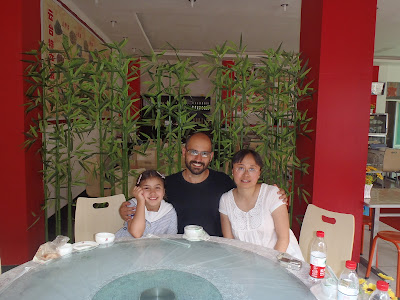
In the wake of my nine hundredth birthday, I take this opportunity to remind the world that time passes for everyone. And sometimes the most unlikely people arrive to remember yourself the same thing. In my case, this duty has fallen upon one person from my past. After 10 years I've met again with my friend Terry, a Chinese woman known during my Erasmus course in Patras, Greece. And with her I've seen again her daughter Athene... or so to speak, because ten years ago she was still in her mother's womb.

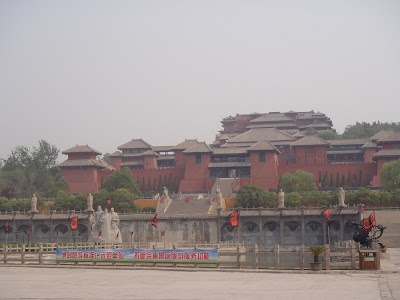
Unfortunately we could not see each other in Beijing, and so she came to visit me here at the school. We spent two wonderful days together and, among other things, we went to see the city of Cinema which is located in Jiaozuo, a 30 minute drive from the school.
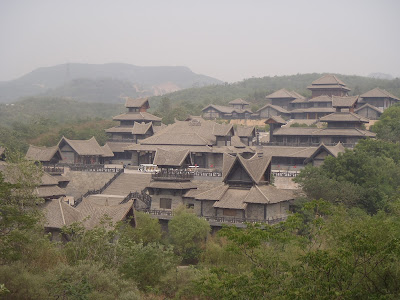
The visit was very funny and interesting... especially because about two months ago I was in New Zealand and I visited the movie set of Lord of the Rings...two different worlds. In New Zealand they have made a multi-millionaire colossal and left almost no trace of the production (they are regretting it now, but never mind). In China, for playing their television series, they've rebuilt entire "imperial" cities scattered around the country and I visited one of them.


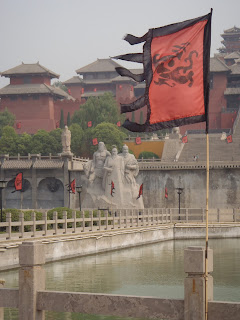
Of course, the impact is impressive. At the entrance you are welcomed by the Three mythological Emperors, whose names of course I cannot remember, dominated by the Chinese Sages - I only remember Confucius - and surrounded by the four Gods representing the cardinal points. These have the form of a tiger / lion, a phoenix, a dragon and a turtle with snake.


There are certain points where you look at the landscape and you seem to be really into the history...then you get closer and you realize that it's all fake, cement and fiberglass. The true is that little remains of the original imperial cities, like the temples of which we have already spoken.


Wise Mandarins, to make you feel more the atmosphere, have organized a "historical" clothing rental service, with which you can go around the city. The fanatics of historical reconstructions might find a thousand reasons to complain, especially for the fabric used, but the final effect is compelling. Especially if you pay a guide to tell you the story and if you have a Chinese friend who translate it in English for you :-P 

This China is incredible, but it exists. 
May the Force be with us!


[Luke] Non posso crederci! [Yoda] Ecco perché hai fallito.


Sulla scia del mio novecentesimo compleanno, approfitto per ricordare al mondo che il tempo passa per tutti. E a volte a ricordartelo sono le persone più improbabili. A ricordarlo a me è piombata nel mio presente una persona del mio passato. Dopo 10 anni mi sono rivisto con la mia amica Terry, cinese conosciuta durante il mio corso Erasmus a Patrasso, Grecia. E con lei ho rivisto anche sua figlia Athene. Rivisto si fa per dire... Dieci anni fa era ancora nella pancia della mamma.


Purtroppo non siamo riusciti a vederci a Pechino, e così lei mi è venuta a trovare qui alla scuola. Abbiamo passato due bellissime giornate assieme e, tra le altre cose, siamo andati a vedere la città del Cinema che si trova a Jiaozuo, 30 minuti di macchina dalla scuola.

La visita è stata molto divertente ed interessante... Soprattutto perché quasi due mesi prima me ne sono andato in giro per la Nuova Zelanda a visitare i set cinematografici del signore degli anelli... Due mondi diversi. In nuova Zelanda hanno girato un colossal multi milionario e non hanno lasciato quasi nessuna traccia (adesso se ne stanno pentendo, ma pazienza). In Cina, per girare i loro serial televisivi, hanno ricostruito intere città "imperiali" sparse per la nazione e io ho visitato una di queste.


Certo, l'impatto è impressionante. All'ingresso ti accolgono tre imperatori mitologici, di cui ovviamente non ricordo il nome, sovrastati dai saggi cinesi, di cui ricordo solo Confucio, e circondati dalle quattro divinità che rappresentano i punti cardinali. Questi dei hanno forma di tigre/leone, fenice, drago e tartaruga con biscione..


Ci sono certi punti in cui guardi il paesaggio e ti sembra veramente di essere dentro la storia... Poi ti avvicini e ti accorgi che è tutto finto, cemento e vetroresina. Del resto delle città imperiali vere è rimasto poco, come per i templi di cui abbiamo già parlato.


Sapientemente i Cinesi, per farti calare maggiormente nel clima, hanno organizzato un servizio di noleggio vestiti "storici" coi quali puoi andare in giro per la città. I fanatici di ricostruzioni storiche potrebbero trovare mille motivi per lamentarsi, soprattutto per i tessuti usati, ma l'effetto finale è avvincente. Soprattutto se paghi una guida per raccontarti la storia e se hai una amica cinese che te la traduce in inglese :-P 
Questa Cina è incredibile, eppure esiste. 
Che la Forza sia con noi!!


Thursday, 13 June 2013

Wars no make one great.


Luke was looking for a great warrior who could teach him the way of the Force, but Yoda told him that war does not make one great. In the same way at the Shaolin temple around 30,000 people, including teachers and students, train without looking for a war (or at least at the moment, but this is a matter for another post).


Since China has discovered that the world is interested in the Chinese martial arts, the schools have flourished and some, like mine, also welcome foreigners. In this way, the Chinese people also try to take back part of their culture, which had been banned during the Cultural Revolution.

When the masters were forced to train in secret. In the Shaolin Temple still exists the room where these masters were trained and with their kicks have broken the floor


The rest of the temple is almost entirely new. Obviously rebuilt after the destruction of the revolution. Even the Shaolin monks are gone, but these seem to have disappeared in more recent times. A decade ago there were still some there. Today it seems that you simply choose between being a Buddhist monk or being a teacher dedicated to kung fu. So around the temple you see Buddhist monks with their typical clothes or, on the one hand, swarms of young people training.


I think it is a bit 'a shame. The union of physical and spiritual training made of the Shaolin monk a very interesting figure. But I think that's a minor issue in this strange land of China.